
Impermanent loss, explained —
and how to stay ahead of it
A clear guide to impermanent (divergence) loss for AMM liquidity providers — what it is, how big it gets, and how to keep fees out-earning it.
What is divergence loss?
Divergence loss (often called impermanent loss) is the gap between holding your tokens in a liquidity pool versus simply holding them in your wallet. When the price of the two pooled assets moves apart, the pool rebalances against you — selling the appreciating asset and buying the depreciating one.
It's where our name comes from: when prices mean-revert toward your entry, the divergence cancels out — fully, or partly if they don't return all the way. The loss only locks in when you withdraw. The real question for an LP isn't whether divergence happens — it's whether your trading fees out-earn it.
And with concentrated liquidity, a static rule of thumb doesn't cut it. Your actual divergence depends on your range, time-in-range, and fees earned. That's why we built two tools: a simulator that computes your exact divergence loss at any price you choose, and a backtester that replays your range against real historical data.
Don't estimate — know
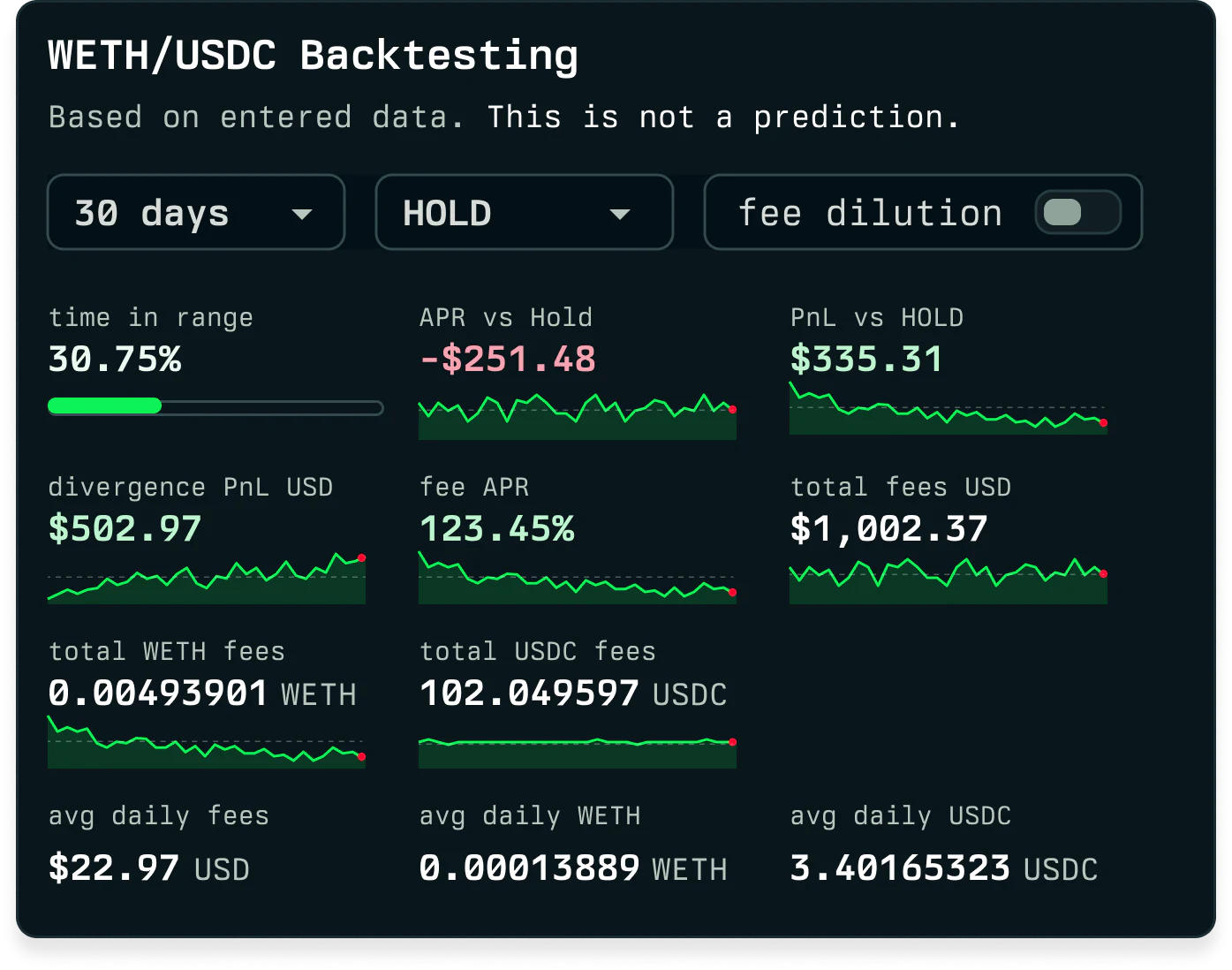
The simulator computes your exact divergence loss at any price you choose. The backtester replays the same range against real historical data for fees, time-in-range, and APR — so you can size a position around real numbers, not rules of thumb.
How Revert helps you stay ahead of divergence loss
You can't stop prices from moving — but you can measure divergence precisely, test a range before you commit, and cap the downside when the market turns.
See divergence PnL in real time
Revert shows every LP position in rich detail — fee APR, uncollected fees, divergence PnL, ROI, and total PnL vs. HOLD — so you always know whether fees are out-earning impermanent loss.
Know your divergence loss at any price
The simulator lets you set your range and any price you want, then computes exactly what your divergence loss will be — so you can size a position around real numbers, not rules of thumb.
Test a range against real history
The backtester replays a draft position's range and amounts against historical data to compare time-in-range, fees, APR, and divergence PnL before you ever deposit.
Cap the downside with a set exit
Set one or both target prices and let Auto-Exit execute when they're reached — reduce drawdowns and take profit without watching the chart.
Impermanent loss, answered
Is impermanent loss the same as divergence loss?+
Yes. Divergence loss is the more precise term — it's the loss caused by the prices of the two pooled assets diverging. Revert reports it as divergence PnL on every position.
Does impermanent loss mean I always lose money?+
No. Impermanent loss measures performance versus simply holding the tokens. If the trading fees you earn exceed the divergence, your position still comes out ahead of HODL. The goal is to track both sides and keep fees winning.
Is divergence loss always a bad thing?+
Not necessarily. Divergence loss is really just the pool rebalancing your holdings as prices move — and some LPs want exactly that. You can use a range to express a directional view: stay close to a 50/50 split of two assets, or set bounds where you'd be happy ending up entirely in one token. Used deliberately, that "loss" is just automated rebalancing toward an allocation you chose.
How is impermanent loss different on Uniswap V3?+
Concentrated liquidity earns more fees inside your chosen range, but divergence is amplified if price moves through or out of that range. A static full-range rule of thumb no longer applies — you need to simulate your exact position.
Can I avoid impermanent loss entirely?+
Not entirely while providing two-sided liquidity, but you can manage it: simulate the position first, pick pools and ranges where fees out-earn expected divergence, and exit at planned prices. Revert's analytics, simulator, backtester, and Auto-Exit are built for exactly this.
Know exactly what your LP positions earn
Connect a wallet — it's free — and see fee APR, divergence PnL, and total PnL vs. HOLD across Uniswap, PancakeSwap, and more.
